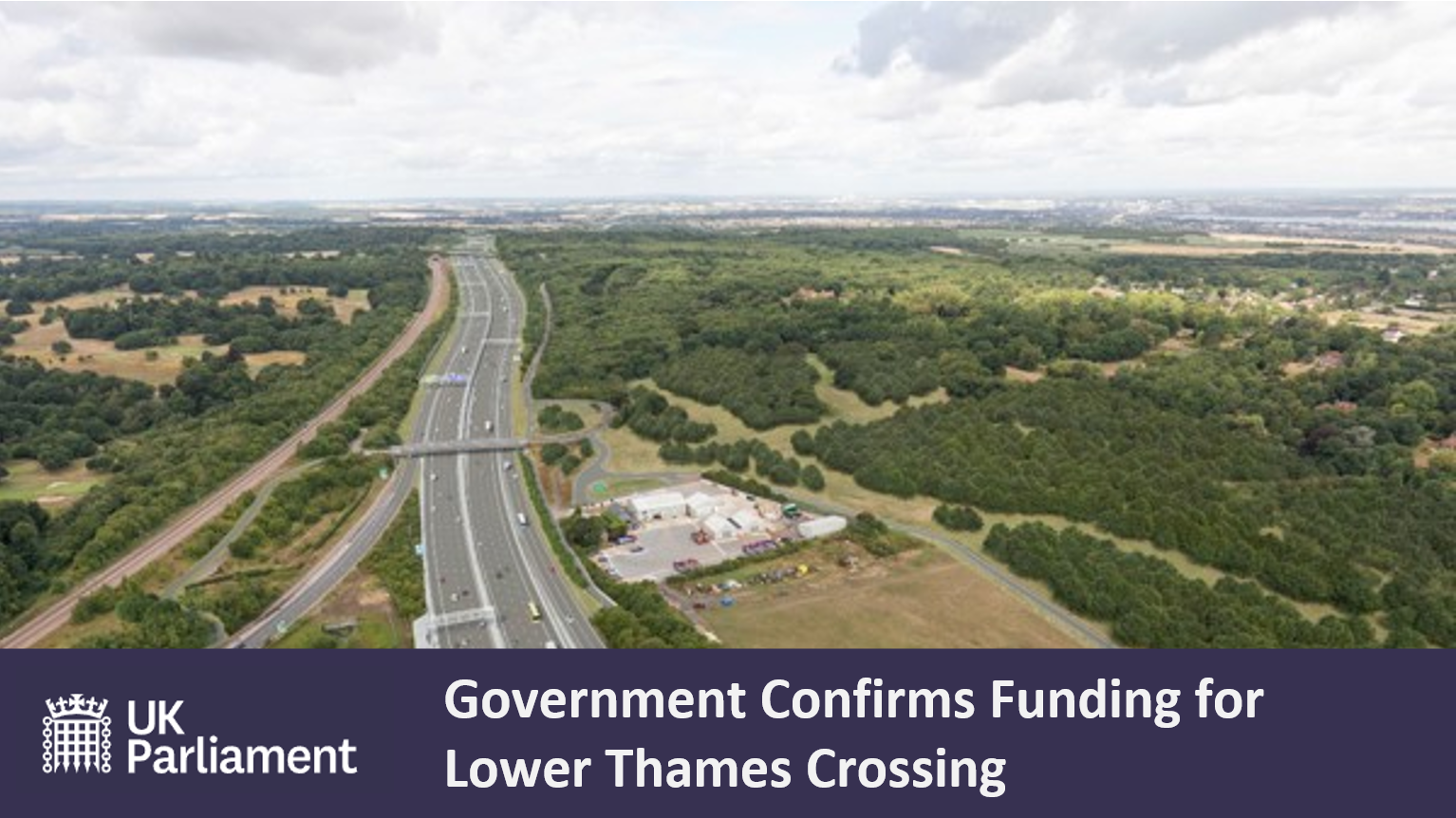
Government Confirms Funding for Lower Thames Crossing — But Evidence is Still Missing
In today’s Budget speech, Chancellor Rachel Reeves confirmed that the Government will provide investment for the Lower Thames Crossing (LTC), describing it as part of a national programme of infrastructure intended to drive economic growth.
“As we allocate investment for the infrastructure that is the backbone of economic growth across our country, today I will commit investment for the Lower Thames Crossing.”
— Budget Statement, 26 November 2025
This is the strongest indication yet that Treasury support for the project remains intact. For residents, businesses and campaigners on both sides of the estuary, the announcement brings clarity in one respect — funding is politically approved. But in another, arguably more important respect, it raises an immediate and uncomfortable question:
Where is the evidence that justifies spending public money on this scheme?
OBR Documents Contain No LTC Assessment
Despite the Chancellor’s commitment from the dispatch box, the Lower Thames Crossing does not appear once in the Office for Budget Responsibility’s newly-released Economic and Fiscal Outlook (EFO).
- No cost line.
- No benefit justification.
- No projected revenue or economic return.
- No independent scrutiny.
The EFO shows the national fiscal position, long-term debt expectations and the Government’s overall spending envelope – but it offers no assessment of whether LTC represents sound investment, nor any appraisal of alternatives. For a scheme expected to exceed £9bn and predicted by National Highways to reduce congestion at Dartford by only 14%, this absence is significant.
Funding may have been announced, but it has not been justified.
Public Commitment Must Be Matched By Public Evidence
If billions of pounds in taxpayer money are to be spent, the Government must demonstrate that the scheme delivers more relief, more resilience, more environmental protection and better long-term outcomes than alternative approaches.
Right now, the public does not have that evidence.
- No updated demand forecasts.
- No sensitivity modelling.
- No transparent lane-balance assessment for the A2/M2 corridor.
- No published turning-movement analysis for J2.
- No like-for-like evaluation against a long-tunnel alternative.
Every one of those missing elements matters — not just for Kent and Essex, but for the national balance sheet. The Lower Thames Crossing is now a funded project. Yet on the numbers available today, the public is expected to accept it on faith, not facts.
LTCA’s Position
The Lower Thames Crossing is a decision with consequences;
environmental, financial and generational. If government intends to invest, it must also justify.
We therefore call on the Treasury, National Highways and the Department for Transport to:
-
Publish the full LTC business case
-
Release updated traffic forecasts, including sensitivity tests
-
Provide the A2/M2 lane-balance modelling
-
Disclose J2 turning-movement and diversion analysis
-
Present a transparent comparison with long-tunnel alternatives
Funding is confirmed – but evidence remains absent.
Until that gap is filled, the public cannot be expected to accept this project as value for money.